
How a Second Brain App May Help People With ADHD Manage Information Overload
Recall is an AI second brain that helps people with ADHD save, summarize, and chat with videos, podcasts, and PDFs so
Press Release Disclaimer: This is a press release distributed through the XPR Media network. It has not been independently verified by our newsroom.
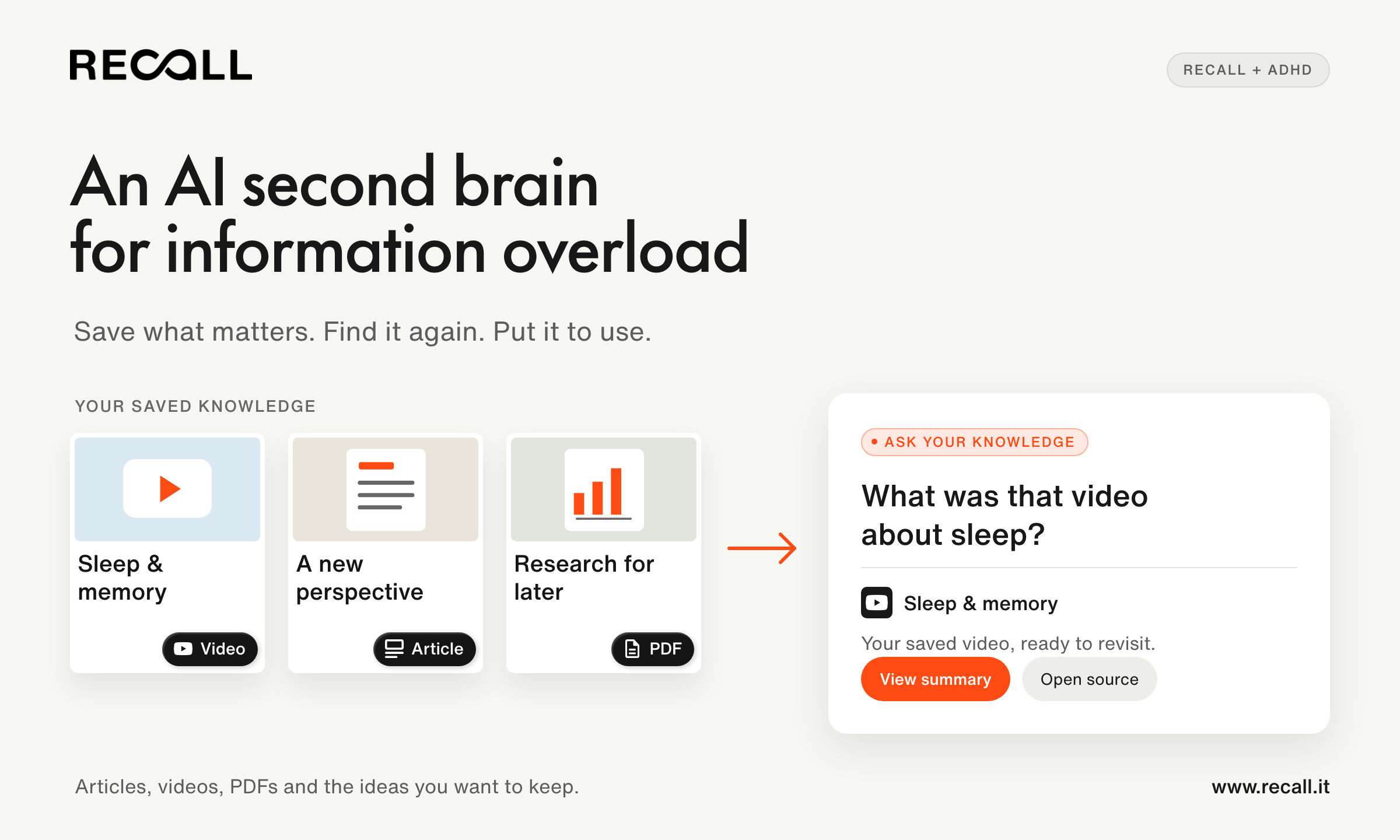

Recall is an AI second brain that helps people with ADHD save, summarize, and chat with videos, podcasts, and PDFs so they get the gist with less mental load.
SAN FRANCISCO, CA, UNITED STATES, October 20, 2026 /EINPresswire.com/ — Most ADHD apps manage time. Yet the problem with ADHD often isn’t time; it’s information overload. Recall is a second brain app used by more than 700,000 people that helps people with ADHD save, summarize, organize, and chat with their knowledge so they get the gist without the mental load.
An article worth reading. A video worth watching. A report worth keeping. For people with ADHD who struggle with information overload, the challenge isn’t just staying focused. It’s finding a way to save useful information, return to it, and put it to use.
In a targeted Recall customer survey of respondents who identified themselves as having ADHD or as neurodivergent, more than a third selected getting distracted before finishing a task as the biggest drain on their productive time.
The Graveyard of Good Intentions:
Respondents were asked where their saved information used to end up before using Recall. Nearly two-thirds named notes apps with no organization, and more than half named browser tabs they never closed. Others pointed to phone screenshots they never looked at again and apps they had stopped opening. Nearly half said they had never found a system that worked.
Over time, disorganization can start to feel like a personal failing. Recall believes it’s not the user’s fault, but rather a matter of finding the right system, such as Recall’s AI second brain, which can do the heavy lifting for them.
The Three Challenges of Information Overload:
Respondents were asked which of three information challenges they faced.
1) Saving it in the first place.
2) Finding it again when they needed it.
3) Actually doing something with what they had saved.
61% chose “all three, in a cycle I couldn’t break,” referring to saving something, finding it again, and actually doing something with it. Of the remaining respondents, more said the hardest part was using what they had saved than finding it again.
That helps explain why tools built only for capture, or only for search, can leave part of the problem unresolved. This is where the case for an AI second brain to help manage information overload comes in.
Planners, timers, and other ADHD apps help with scheduling and task management. But the survey highlighted another challenge, managing the information people want to keep. Respondents described articles lost among open tabs, notes without organization, and saved content they struggled to find or use again.
Recall addresses that information workflow with an AI second brain, a personal knowledge base that helps users keep useful information outside their memory and retrieve it when they need it. It summarizes saved content, connects related ideas automatically, and lets users ask questions across what they’ve saved, helping them manage information overload without building an elaborate filing system.
Ricardo, a Recall power user and content experience designer, described it this way. “Recall absorbs the executive function load (organizing, remembering, connecting) so the ADHD brain can do what it’s actually good at: pattern-spotting, associative leaps, and hyperfocus on what’s interesting.”
For a practical walkthrough, see how to use Recall to manage information overload, from saving content to finding and using its key ideas later.
What Survey Respondents Reported After Using Recall:
For most respondents, it didn’t take long. Nearly two-thirds said Recall clicked immediately or became their go-to app within the first week.
The change was emotional as well as practical. In the survey, 77% said Recall had reduced their anxiety around forgetting and getting things done. Including those who said they felt more capable and confident, more than four in five described a positive change in how they felt about their own memory.
These are self-reported customer experiences, not evidence that Recall treats ADHD or clinically reduces anxiety.
Respondents also said the wider industry has some catching up to do. The most common view, held by nearly half, was that tech companies’ understanding of how people with ADHD manage information is improving, but slowly.
About the Recall Survey:
Recall surveyed customers who had identified themselves as having ADHD or as neurodivergent. These customers represented 2% of Recall’s customer base.
The findings reflect the self-reported experiences of respondents within this targeted customer group. They are directional and should not be interpreted as representative of all Recall users, everyone with ADHD, or the wider neurodivergent population.
Participants’ identification as having ADHD or as neurodivergent was self-reported rather than established through a clinical assessment. References to survey respondents do not imply that every participant had ADHD. The survey describes customer experiences and does not establish clinical outcomes or causation.
About Recall:
Recall is an AI second brain and personal AI knowledge base used by more than 700,000 people. It saves articles, YouTube videos, podcasts, PDFs, and notes, summarizes them, connects related ideas, and lets users ask questions across what they’ve saved.
It is available on the web, iPhone, Android, Chrome, Firefox, Edge, and Safari. Recall was founded in 2022 and is headquartered in Amsterdam. The founders are Paul Richards, chief executive; Igor Gligorevic, chief technology officer; and Sankari Nair, chief operating officer.
It is free to start at www.recall.it.
Sankari Nair
Recall.Wiki Inc
sankari@recall.it
Visit us on social media:
LinkedIn
Instagram
YouTube
X
Other
My ADHD Second Brain: How This ADHD App Helps Me Feel Less Overwhelmed
Legal Disclaimer:
EIN Presswire provides this news content “as is” without warranty of any kind. We do not accept any responsibility or liability
for the accuracy, content, images, videos, licenses, completeness, legality, or reliability of the information contained in this
article. If you have any complaints or copyright issues related to this article, kindly contact the author above.

Media gallery
