
Vadzo Imaging Validates Bolt-234CGH for Motion Accurate Drone Imaging with Rockchip RV1126: 2MP Onsemi AR0234 Global Shutter Autofocus MIPI Camera
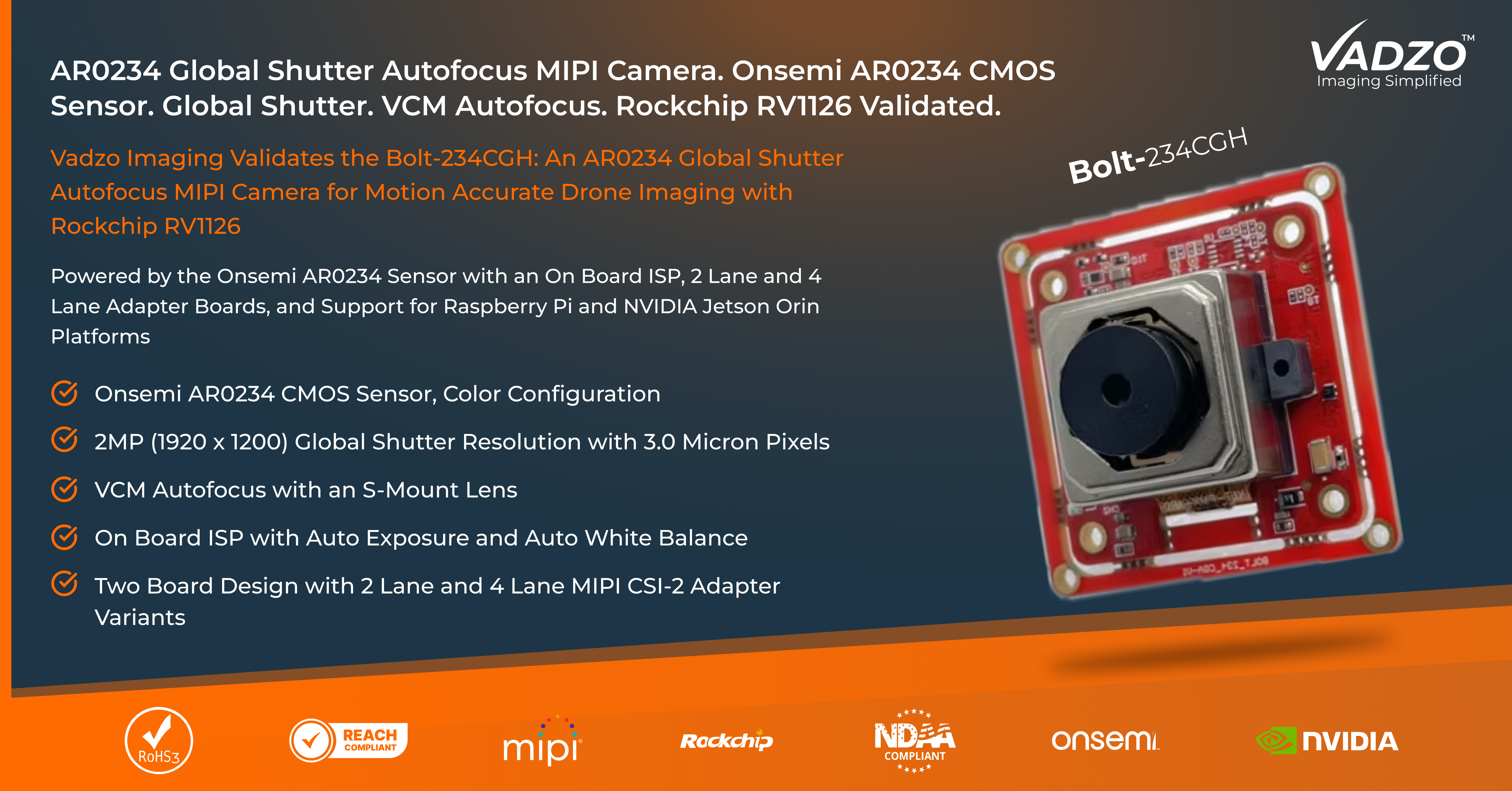
The Bolt-234CGH is a 2MP Onsemi AR0234 Global Shutter Autofocus MIPI Camera, and Vadzo has validated it with the
Press Release Disclaimer: This is a press release distributed through the XPR Media network. It has not been independently verified by our newsroom.


The Bolt-234CGH is a 2MP Onsemi AR0234 Global Shutter Autofocus MIPI Camera, and Vadzo has validated it with the Rockchip RV1126 for motion-accurate drone imaging. A drone camera has to stay accurate while the aircraft vibrates, banks, and flies at speed. A global shutter exposes every pixel at the same instant, so edges stay straight and the geometry that navigation and obstacle detection depend on stays true. A voice coil motor autofocus lets the same camera serve close inspection and landing as well as distant views. An on-board ISP finishes the image, and the module sends Full HD video over MIPI CSI-2 directly to the processor, which saves the weight and power of a USB controller. As a 2MP Global Shutter MIPI Camera and a 2MP Rockchip RV1126 MIPI Camera, it also supports Raspberry Pi and NVIDIA Jetson Orin Nano, Orin NX, and AGX Orin. Designed for drone and UAV makers, it supplies undistorted, correctly exposed frames to the flight computer.
FORT WORTH, TX / ACCESS Newswire / October 27, 2026 / Vadzo Imaging, a provider of embedded vision camera products for OEMs and system integrators, today announces validation of the Bolt-234CGH with the Rockchip RV1126 for motion-accurate drone imaging. The Bolt-234CGH is an AR0234 Global Shutter Autofocus MIPI Camera built on the Onsemi AR0234 sensor, with VCM autofocus, an on-board ISP, and a two-board design that offers 2-lane and 4-lane adapter boards. With this validation, Vadzo presents a 2MP Autofocus MIPI CSI-2 Camera for drone navigation, obstacle avoidance, and imaging, together with guidance on obstacle detection range, power and weight, and the careful use of autofocus in flight.
Why an AR0234 Global Shutter Autofocus MIPI Camera Suits Motion-Accurate Drone Imaging
Drones use camera systems for three jobs that ask different things of the sensor. Imaging records what the aircraft sees, and it wants sharp, correctly exposed frames. Navigation, including visual odometry and mapping of the surroundings, wants frames whose geometry is true, because the software measures how features move from frame to frame. Obstacle avoidance wants the same accuracy at the shortest possible delay, because the aircraft has little time to react. All three suffer when the picture is distorted by motion. A camera that stays accurate under vibration therefore supports every job at once.
Most sensors read the picture row by row. On an aircraft that vibrates and moves, each row captures a slightly different moment, so vertical lines lean and the image wobbles. The effect is easy to ignore in a casual video and damaging for software that measures motion, since the wobble looks like real movement. A global shutter removes it by exposing every pixel at the same instant. Short exposure times add to the benefit, since fast flight and low light push exposure times down and noise up, and larger pixels help hold the signal. Late afternoon flights benefit most from that margin.
Weight and power set the third limit. Every gram on a small aircraft costs flight time, and every watt drawn from the same battery as the motors takes a share of it. Camera designs that need a separate USB controller, a bridge chip, or a heavy cable add both. A direct MIPI connection to the processor avoids the extra silicon, and a compact two-board design keeps the mass down. Autofocus is the fourth question. A moving lens is useful for close work and risky in flight, since a lens that hunts for focus during a maneuver can blur the frames the software needs. Designers therefore need to decide early when focus is allowed to move.
Teams that discover these constraints after the airframe is built must change the camera, the processor board, or the flight software, which is slow and costly in a program with strict weight and power budgets. A short calculation of range, weight, and power at the start avoids most of that rework.
How an AR0234 Global Shutter Autofocus MIPI Camera Works with the Rockchip RV1126
The Bolt-234CGH is built on the Onsemi AR0234, a 2MP (1920 x 1200) color global shutter sensor with a 1/2.6 inch optical format and 3.0 micron pixels. The global shutter exposes and holds every pixel at the same instant and then reads them out, so motion and vibration do not bend the picture. The 3.0 micron pixels are large for a 2MP sensor, which gathers more light and lets exposure stay short. An S-Mount lens with VCM autofocus lets the camera refocus when the subject distance changes, for example when a drone descends toward a landing pad or approaches a structure for inspection. Between those moments, the focus can be held fixed for flight.
The on-board ISP finishes the image inside the module. It performs debayering, demosaicing, color correction, contrast correction, gamma correction, denoising, and lens corrections, and it supports auto exposure and auto white balance. The module outputs YUV422, so the processor receives a finished image and does not need to tune an ISP profile for the sensor. The Rockchip RV1126 combines an image processor, a hardware video encoder, and a neural processing unit in one compact chip, which suits a small aircraft. Vadzo has validated the camera with the RV1126, so a team can run navigation or obstacle detection on the NPU while the encoder records or streams video. The module also supports Raspberry Pi and NVIDIA Jetson Orin Nano, Orin NX, and AGX Orin for teams that need more compute. The same camera can therefore follow a project from a bench prototype to a flight article.
A simple calculation shows how far a 2MP camera can see an obstacle. The angle covered by one pixel is the pixel pitch divided by the focal length. With 3.0 micron pixels and an example 4 millimeter lens, one pixel covers about 0.75 milliradians. A pole 0.5 meters across at 20 meters subtends 25 milliradians, which is about 33 pixels. At 50 meters, the same pole covers about 13 pixels. Detection generally needs fewer pixels than classification, so the usable range depends on the software. These numbers are illustrative and depend on the lens, and they show why a team should calculate range from its own lens and obstacles. A longer lens raises pixels on a distant obstacle and narrows the view, so some aircraft carry two camera units with different lenses.
Power deserves context. A camera that draws about one watt on an aircraft whose motors draw about one hundred watts changes flight time by roughly one percent, so weight usually matters more than camera power on a multirotor. Even so, a direct MIPI link and a compact board help on both counts, which makes the module an AR0234 Low Power MIPI Camera and a 2MP Low Operational Power MIPI Camera for flight use. The module is a two-board solution with an adapter board in two variants, one for 2-lane MIPI CSI-2 and one for 4-lane. Full HD video is supported, and the 4-lane variant offers the highest frame rates, so teams should confirm the rates for each lane count against the product documentation. Vadzo advises locking focus before a maneuver, since autofocus is best used for close work and held fixed in fast flight. Teams can add a simple rule to the flight software that locks focus above a chosen speed.
Mounting and vibration deserve a short note, because they decide how much of the camera’s accuracy reaches the software. A global shutter prevents skew within a frame, but it does not stabilize the picture from one frame to the next, so a damped mount or a gimbal is still the right answer for steady footage. The lens should be fixed firmly, since an S-Mount lens can shift under vibration if it is not secured, and the flat cable between the boards should have strain relief so that the connector stays seated. Teams should also keep the camera away from heat sources such as the processor and the motor controllers, because a warm sensor is a noisier sensor. These are ordinary airframe design choices, and Vadzo can review the mounting and enclosure with a customer during evaluation, so that the first flight article behaves like the bench prototype.
Product Overview
The Bolt-234CGH is a 2MP color MIPI module built on the Onsemi AR0234 sensor and validated with the Rockchip RV1126 for motion-accurate drone imaging. As a 2MP Global Shutter CSI-2 Camera, it keeps geometry true during flight, and as a 2MP VCM Autofocus MIPI Camera, it can refocus for close work. The AR0234 Low Operational Power MIPI Camera designation reflects its compact two-board design and direct MIPI connection, and the 2MP RV1126 Global Shutter MIPI Camera designation covers its validation with the Rockchip RV1126. The module combines the sensor, an on-board ISP, and an S-Mount lens holder with VCM autofocus. It also serves as an AR0234 VCM Autofocus MIPI CSI-2 Camera, a 2MP Global Shutter MIPI Camera, an AR0234 Global Shutter MIPI CSI-2 Camera, and a 2MP Low Power Autofocus MIPI Camera for designs that need a standard MIPI interface.
Key specs: 2MP (1920 x 1200) Max Resolution | Onsemi AR0234 1/2.6 inch Sensor Format | 3.0 micron Pixel | Color with Global Shutter | 2 Lane and 4 Lane MIPI CSI-2 Interface | S-Mount Optics with VCM Autofocus
Key Capabilities of the AR0234 Global Shutter Autofocus MIPI Camera
Global Shutter Imaging for Motion-Accurate Flight Data
A global shutter exposes every pixel at the same instant, so vibration, banking, and speed do not bend the picture. Navigation and obstacle avoidance software measures how features move between frames, and a rolling shutter makes the wobble of the airframe look like real motion. The global shutter removes that source of error and keeps the geometry true. The 3.0 micron pixels also let exposure stay short in modest light, which limits motion blur in fast flight. Short exposures also help the navigation software track features reliably.
VCM Autofocus for Close-Range Drone Inspection
A voice coil motor moves the lens quickly and electrically, so the camera can bring a nearby subject into focus without manual adjustment. This helps when a drone approaches a structure for inspection or descends toward a landing pad. In fast flight, a lens that hunts for focus can blur frames, so Vadzo recommends locking focus before a maneuver, using autofocus for close work and a fixed setting for navigation. Teams should test focus behavior on their own aircraft and confirm the focus range against the product documentation. A printed chart at several distances makes the check quick.
Onboard ISP for Image Processing and Color Correction
The on-board image signal processor finishes the picture inside the module, performing debayering, demosaicing, color correction, contrast correction, gamma correction, denoising, and lens corrections, with auto exposure and auto white balance. The processor receives a finished YUV422 image, so no ISP profile has to be built for the sensor, which saves weeks of tuning and keeps color the same on every platform. Teams that need raw data and custom tuning should discuss a raw sensor module with Vadzo instead. For most drone projects, a finished image from the first day shortens development.
Rockchip RV1126 Integration and AI Processing Support
The Rockchip RV1126 is a compact processor with an image pipeline, a hardware video encoder, and a neural processing unit, which suits a small aircraft with limited weight and power. Vadzo has validated the camera with the RV1126, so it works as an AR0234 RV1126 MIPI Camera, a 2MP Rockchip RV1126 MIPI Camera, and an AR0234 Rockchip MIPI Camera from the first day of evaluation. Because the camera sends a finished image, the RV1126 can pass frames to inference and to the encoder without first tuning its own ISP. That keeps the processor’s capacity free for the flight software.
Compatibility with Raspberry Pi and NVIDIA Jetson Orin
Teams that need more compute can use the same camera with Raspberry Pi or with NVIDIA Jetson Orin Nano, Orin NX, and AGX Orin. This lets a drone maker prototype on a familiar development board and move to the RV1126 for flight, or scale up to a Jetson module for heavier workloads, without changing the camera. The connector on each carrier board determines which adapter fits, and Vadzo helps teams match them. Planning the connector choice early lets the carrier board and wiring be designed once.
Full HD Video Streaming over MIPI CSI-2
Full HD is the working resolution for most drone navigation and imaging software, since it gives enough detail while keeping processing and storage manageable. The module streams Full HD over MIPI CSI-2 directly to the processor, which avoids the delay and weight of a USB bridge. The 4-lane adapter provides the bandwidth for the highest frame rates, and teams should confirm the available modes and rates for the autofocus model before they design their pipeline around them. A short bench test with the real processor shows the achievable rate.
Two-Board Design with 2-Lane and 4-Lane MIPI CSI-2 Adapters
The module is a two-board solution, with the camera board and an adapter board, and the adapter comes in two variants, one for 2-lane MIPI CSI-2 and one for 4-lane. The 2-lane variant suits hosts with a simple camera connector, and the 4-lane variant carries more data for faster frame rates. Teams choose the variant that matches their carrier board, and they can change it later without changing the camera board. As a 2MP MIPI Camera Manufacturer, Vadzo supports adapter selection, lens matching, firmware customization, and enclosure design for volume programs. Teams that move from a bench test to a flight test keep the same module and documentation.
“Drone makers count grams and watts, and they cannot afford a camera that bends the picture. The Bolt-234CGH was validated with the Rockchip RV1126 around three ideas. A global shutter keeps the geometry true while the aircraft shakes and moves. A direct MIPI connection saves the weight and power of a USB controller. And a voice coil autofocus lets the same camera serve close inspection, with a clear recommendation to lock focus in fast flight. We would rather tell customers that than promise autofocus everywhere. We also encourage them to calculate obstacle detection range for their own lens, because that number decides how much time the aircraft has to react.” – Alwin Vincent, Product Manager, Vadzo Imaging.
Drone and UAV Applications for Navigation, Inspection, and Obstacle Detection
Close-Range Drone Inspection of Infrastructure and Assets
Inspection flights approach towers, roofs, and pipelines at close range, where detail matters and the aircraft moves slowly. The Bolt-234CGH works as a Drone Imaging MIPI Camera whose autofocus brings nearby surfaces into focus and whose ISP delivers correctly exposed frames, and as a Motion Accurate Drone MIPI Camera, it keeps edges straight during gentle maneuvers. Teams should lock focus before faster passes and check the lens against the standoff distance. Operators can also record full frames for later review while the pilot watches a lower resolution view.
UAV Navigation and Environmental Mapping
Navigation software estimates motion from the changes between frames, and distortion corrupts that estimate. The module serves as a UAV Navigation MIPI Camera whose global shutter keeps the frames geometrically consistent, and as a Drone Global Shutter MIPI Camera, it suits visual odometry and mapping on aircraft that vibrate and bank. Full HD over MIPI keeps the delay between exposure and processing low. Teams that map their surroundings gain from consistent frames across a whole flight, and teams that fly indoors, where satellite positioning is weak, rely on visual navigation even more.
Obstacle Detection and Avoidance Using Global Shutter Imaging
Obstacle avoidance needs accurate frames with the shortest delay, and range depends on pixels on the obstacle. The camera functions as a Drone Obstacle Avoidance MIPI Camera that gives the software undistorted frames, and the RV1126 neural processing unit can run detection on the aircraft. Teams should calculate detection range from their lens and obstacle size, and they should use a fixed focus setting at flight speed. Testing with real obstacles at known distances confirms the result.
Embedded MIPI Camera Integration for Drone and UAV Platforms
Drone makers choose compute and camera together. The Bolt-234CGH works as an Embedded Camera for Drones Application and an Embedded Camera for UAV Application with a compact two-board design and a direct MIPI connection to the RV1126, Raspberry Pi, or the NVIDIA Jetson Orin family. Teams should check weight, vibration limits, and connector retention for their airframe. A small amount of strain relief on the flat cable prevents most connector problems.
Frequently Asked Questions
Q: Can a drone camera use autofocus safely in flight?
A: Vadzo Imaging recommends using autofocus for close work and locking focus in fast flight. A voice coil motor autofocus is valuable when a drone approaches a structure or descends toward a landing pad, because it brings nearby surfaces into focus without manual adjustment. In a fast maneuver, a lens that hunts for focus can blur the frames that navigation software needs, so teams should set a fixed focus before such moments and test the behavior on their own aircraft. A short test flight with focus locked and unlocked shows the difference clearly.
Q: How far can a 2MP camera see an obstacle?
A: It depends on the lens and the size of the obstacle. The angle covered by one pixel equals the pixel size divided by the focal length, so a longer lens puts more pixels on a distant object. For example, with 3.0 micron pixels and a 4 millimeter lens, a pole half a meter wide covers about 33 pixels at 20 meters and about 13 at 50 meters. Detection needs fewer pixels than classification, and Vadzo Imaging helps teams calculate range for their lens, and a 2MP Global Shutter MIPI Camera suits that calculation well because its pixel size is known.
Q: Why use MIPI instead of USB on a drone?
A: A MIPI camera connects directly to the processor, which avoids a USB controller or bridge chip. That saves weight and power, and it reduces the delay between exposure and processing, which matters for navigation and obstacle avoidance. The trade-offs are shorter cable runs and a connector that must match the board. Vadzo Imaging offers adapter boards for 2-lane and 4-lane connections, and it helps teams match them to their processor, including a 2MP Rockchip RV1126 MIPI Camera setup for compact flight computers.
Q: What does a two-board camera solution mean?
A: It means the camera consists of a camera board, which carries the sensor and lens, and an adapter board, which connects it to the processor. The adapter comes in two variants, one for 2-lane MIPI CSI-2 and one for 4-lane, so the same camera board works with different hosts. Vadzo Imaging recommends choosing the adapter that matches the connector on the carrier board and the frame rate the application needs, since the adapter can be changed later without changing the camera board.
Q: Why should drone makers choose Vadzo Imaging as their 2MP MIPI Camera Manufacturer?
A: Vadzo Imaging offers more than a camera module built around a capable sensor. Drone makers working with Vadzo Imaging receive a global shutter module with VCM autofocus, an on-board ISP, validation with the Rockchip RV1126, and two adapter board variants, along with candid guidance on when to lock focus in flight and how to calculate obstacle range, plus engineering support for lens selection, firmware customization, and enclosure design. Vadzo Imaging maintains evaluation kits with no minimum order requirement, so teams can test on their own aircraft before committing to volume production.
Availability
The Bolt-234CGH AR0234 Global Shutter Autofocus MIPI Camera built on the Onsemi AR0234 sensor is available now for evaluation and production orders. Evaluation kits include the camera module, the 2-lane or 4-lane adapter board, and platform documentation, with no minimum order requirement. Drone teams can test motion handling on their own airframe, calculate obstacle range with their own lens, and confirm streaming on the Rockchip RV1126 or an NVIDIA Jetson Orin board before committing to a production bill of materials, which tells them more than a datasheet comparison alone. Teams that need a different lens or adapter configuration can ask Vadzo to review the setup. Browse the full range of MIPI camera options at Vadzo’s website or discuss OEM integration requirements for drone and UAV programs.
About Vadzo Imaging
Vadzo Imaging is a global provider of embedded vision solutions and delivers high-performance camera technologies and imaging platforms for applications in robotics, industrial automation, UAVs, edge AI, and medical systems. Its products are designed for seamless integration with leading embedded platforms including Rockchip, NVIDIA Jetson, Raspberry Pi, and NXP i.MX. Vadzo supports customers through hardware customization, firmware development, and module-level drivers, enabling faster development and deployment of vision-based systems across MIPI, USB, GigE, Wi-Fi, and SerDes camera interfaces.
Media Contact
Alwin Vincent
Vadzo Imaging
Email: alwin@vadzoimaging.com
LinkedIn: Vadzo Imaging
YouTube: Vadzo Imaging
X: Vadzo Imaging
SOURCE: Vadzo Imaging
View the original press release on ACCESS Newswire
Media gallery
