TWO YEARS LATER, FASHION’S NEXT GEN MATERIALS FACE A NEW CHALLENGE: CONVERTING INTEREST INTO VOLUME
Sustainabelle Advisory Services has launched the second edition of Next Gen to This Gen: Scaling Material Innovations
Press Release Disclaimer: This is a press release distributed through the XPR Media network. It has not been independently verified by our newsroom.
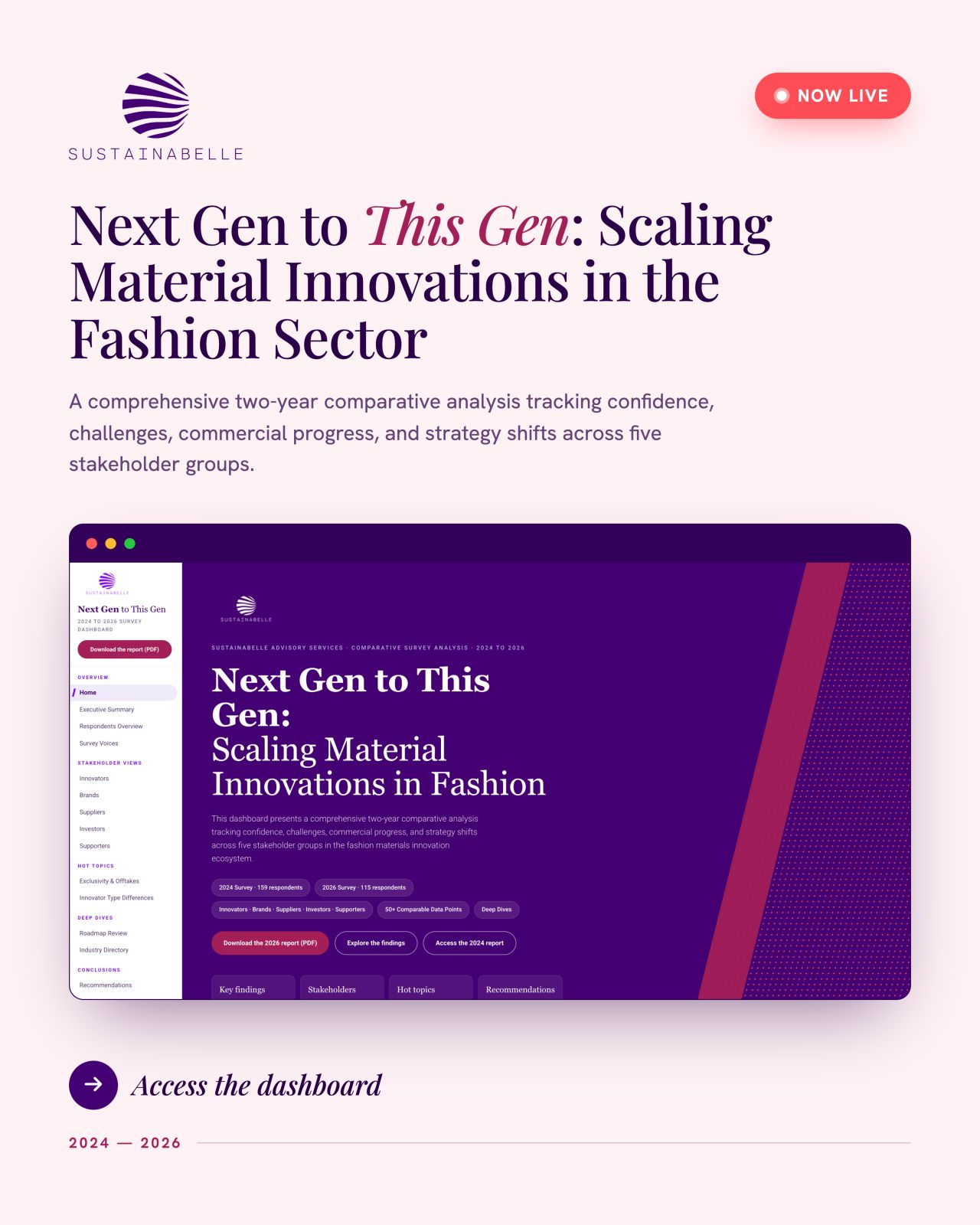

Sustainabelle Advisory Services has launched the second edition of Next Gen to This Gen: Scaling Material Innovations in the Fashion Sector.
PARIS, FRANCE, November 23, 2026 /EINPresswire.com/ — Sustainabelle Advisory Services has announced the launch of the second edition of Next Gen to This Gen: Scaling Material Innovations in the Fashion Sector, its industry research into Next Gen materials in fashion. Presented as an online dashboard, the new edition features the first comparative analysis of the fashion industry’s Next Gen material innovation ecosystem, alongside an industry directory.
Building on Sustainabelle’s 2024 report, Next Gen to This Gen: Scaling Material Innovations in the Fashion Sector, the new research compares industry perspectives from 2024 and 2026 to reveal how confidence, commercial activity, challenges, and priorities are evolving as the sector works to scale.
In 2024, Sustainabelle surveyed 159 industry stakeholders and conducted more than 60 interviews across five stakeholder groups: innovators, brands, suppliers, investors, and industry supporters. In 2026, the survey was relaunched, generating responses from 115 participants across the same stakeholder groups, creating a unique benchmark for understanding how the ecosystem is changing over time.
Between 2024 and 2026, early commercial relationships multiplied. Letters of intent between innovators and brands rose from 48% to 72%, and supplier partnerships from 64% to 82%. But the agreements that commit real volume, offtakes, did not move, holding at roughly 16%. At the same time, the bar for adoption rose: every brand surveyed in 2026 now rates performance and aesthetics a very significant obstacle, and every investor now rates supply chain integration the same way. More relationships forming, a higher bar to clear, and the same conversion gap as two years ago.
“Two years ago the question was whether the industry believed in these materials. It clearly does. What surprised me in the 2026 data is how the bar has risen even as commitment has grown,” said Christine Goulay, Founder and CEO of Sustainabelle Advisory Services. “Brands are now unanimous that performance and aesthetics cannot be compromised, and investors want to see a manufacturing pathway before they back a company. The innovators who scale will be the ones who treat that as the starting point, not an afterthought.”
Key Findings
Four shifts stand out across the two years of data.
1. The industry’s biggest challenge is no longer awareness. It is conversion. Despite growth in commercial activity, offtake agreements remained largely unchanged at around 16 to 17%, highlighting the continued difficulty of translating interest into long term volume commitments.
2. Brands are becoming more focused on commercial performance. The proportion of brands identifying performance and aesthetics as a very significant barrier increased from 84% in 2024 to 100% in 2026, demonstrating that product performance and aesthetics remain an absolute requirement for adoption.
3. Supply chain integration has emerged as a critical scaling challenge. Investors rating supply chain integration as a very significant obstacle increased from 76% to 100%, while suppliers citing lack of brand demand as a major barrier increased from 42% to 62%.
4. The industry increasingly agrees on what is needed to unlock scale. Across both studies, stakeholders consistently identified stronger standards, clearer demand signals, greater regulatory certainty, and new mechanisms to bridge the gap between innovation and commercialization.
Alongside the dashboard, Sustainabelle is launching a new Industry Directory, a resource designed to increase visibility across the Next Gen innovation ecosystem.
Looking Ahead
The 2024 report, Next Gen to This Gen: Scaling Material Innovations in the Fashion Sector, asked how the fashion industry could accelerate the scaling of material innovations. Two years later, the data points to a clearer answer. The need for Next Gen materials is broadly understood, industry interest remains strong, and commercial engagement is increasing. The bottleneck has moved downstream, to conversion.
Conversion from Letters of Intent to offtake agreements. From lab validated innovation to supply chain integration. From pilot collections to category wide adoption. The next phase will depend less on generating interest, which clearly exists, and more on building the legal structures, shared standards, and manufacturing pathways that let a willing brand and a ready innovator transact. Next Gen materials will become This Gen materials when the ecosystem builds the conditions for scale, not just the innovations themselves.
Christine Goulay
Sustainabelle Advisory Services
christine.goulay@sustainabelle.net
Visit us on social media:
LinkedIn
Instagram
YouTube
Legal Disclaimer:
EIN Presswire provides this news content “as is” without warranty of any kind. We do not accept any responsibility or liability
for the accuracy, content, images, videos, licenses, completeness, legality, or reliability of the information contained in this
article. If you have any complaints or copyright issues related to this article, kindly contact the author above.

Media gallery