Following the Silk Road: How Civilizations Enrich One Another
Just another WordPress site
Press Release Disclaimer: This is a press release distributed through the XPR Media network. It has not been independently verified by our newsroom.
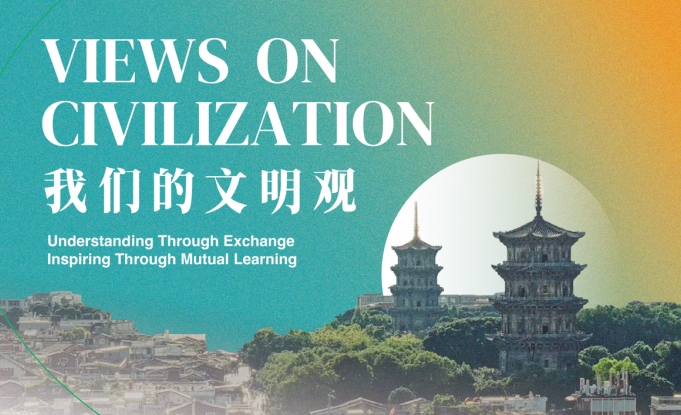

Beijing, China – Nov. 23, 2026 – The Silk Road once brought different regions together through the exchange of goods and skills, while also creating opportunities for ideas, beliefs and ways of life to meet. Centuries later, from the markets of Yiwu to the Mogao Caves in Dunhuang and the streets of Quanzhou, cultural exchange remains not a distant chapter of history, but an everyday reality.
In 2026, the fifth season of the short-video seriesViews on Civilization takes the Silk Road as its central narrative thread, exploring six themes through trade, art, folk customs, science and technology, and intangible cultural heritage: mutual benefit and win-win cooperation, innovation while upholding tradition, mutual learning among civilizations, diversity and inclusiveness, education and national development, and adapting to the times. First launched in 2022, this cultural documentary series once again brings reflections on civilization to life through real people, historical heritage and contemporary experiences.
Produced by the CICG Center for International Cultural Communication, the fifth season continues to be hosted by Anzelika Smirnova, a young Latvian scholar, and features sinologists and experts from various fields. Combining documentary footage with computer-generated imagery (CGI), the series traces the historical evolution of the Silk Road and explores how ancient civilizations continue to evolve in the modern world.
Trade provides a lens through which to understand mutual benefit and win-win cooperation. From ancient Sogdian merchant caravans to today’s international buyers in Yiwu, trade has facilitated the exchange of languages, customs and knowledge. Ivan Sharanov, a professor at the School of International Education at the University of International Business and Economics, explains: “this is a very important piece of this Chinese traditional wisdom that benefits are guided by righteousness. Without benefits, of course, no type of cooperation can exist for a long time. But at the same time, without respecting the other countries, without respecting our trade partners, it is impossible to create long-lasting and sustainable relationship.” He adds that the Digital Silk Road is not about imposing a single set of rules but about enabling countries to become “active participants rather than passive members.”
Ivan Sharanov, a professor at the School of International Education at the University of International Business and Economics, says: “this is a very important piece of this Chinese traditional wisdom that benefits are guided by righteousness. Without benefits, of course, no type of cooperation can exist for a long time. But at the same time, without respecting the other countries, without respecting our trade partners, it is impossible to create long-lasting and sustainable relationship.”
He adds that the Digital Silk Road is not about imposing a single set of rules but about enabling countries to become “active participants rather than passive members.”
From the blend of ancient and modern elements embodied by Baku’s Maiden Tower and Flame Towers, and the digital preservation of Dunhuang’s cultural heritage, to the exchange of food, music and papermaking techniques; from Quanzhou’s multi-religious heritage, Guangzhou’s foreign merchant quarters and Fujian’s guangbing flatbreads spreading to Southeast Asia, to the introduction of the ideas of Bailudong Academy to the Korean Peninsula and the lessons other countries can draw from China’s poverty alleviation practices, this season uses concrete examples to illustrate innovation while upholding tradition, mutual learning among civilizations, diversity and inclusiveness, education and national development, and adaption to changing times. Egyptian translator Abdel Aziz Hamdy believes that mutual learning requires countries to have a need for one another and to learn from each other. Civilizations do not develop in isolation; by respecting differences and embracing one another’s strengths, they each become richer and more diverse.
Video Link: https://www.youtube.com/embed/wgmOjLuCWVI
Together, the six themes point to a common question: In an increasingly interconnected and culturally diverse world, how can people preserve their own traditions while understanding others? This perspective resonates with the Global Civilization Initiative, which calls for respect for the diversity of civilizations, the promotion of the common values of humanity, the importance of inheritance and innovation, and stronger international people-to-people and cultural exchanges and cooperation. Rather than dwelling on abstract concepts, Views on Civilization uses a city, a heritage site, a custom or a cross-cultural experience to help audiences understand the exchange of civilizations through concrete examples.
Since its debut in 2022, the series has continued to explore ways of communicating with international audiences. Its formats have expanded from short videos and micro-documentaries to youth dialogues and podcasts. Documentary footage brings historical and contemporary details to life, while conversations introduce perspectives from different cultural backgrounds. Distribution across multiple platforms has also helped the series reach a wider international audience.
The conclusion of the fifth season is not the end of the journey. Looking back along the Silk Road, we see not only how different regions were connected in the past, but also how these connections can help us navigate cultural differences and preserve shared memories today. Understanding a civilization can begin with a city, an artifact or a dish. Understanding the relationships between different civilizations, however, requires continued engagement, equal dialogue and mutual respect.
Cannot view the video?Visit: https://www.facebook.com/reel/2653863918362616
About Center for International Cultural Communication, CICG
The Center for International Cultural Communication (CICC) is a public institution affiliated with China International Communications Group (CICG). Established in 2021, it is a specialized organization dedicated to fostering people-to-people and cultural exchanges and mutual learning among civilizations, and organizing and implementing major cultural programs and communication initiatives.
Media Contact
Company Name: Center for International Cultural Communication, CICG
Contact Person: Wensi Liu
Email: Send Email
Country: China
Website: https://www.heychinaculture.com/