
Manganese Market Growth: Projections, Drivers & Opportunities
Explore the Manganese Market's projected growth to $49.87B by 2035, driven by steel, EV batteries, and new technologies. Insights on regional trends and opportunities.
Press Release Disclaimer: This is a press release distributed through the XPR Media network. It has not been independently verified by our newsroom.

Asia-Pacific captured 57.4% of the Manganese Market in 2025
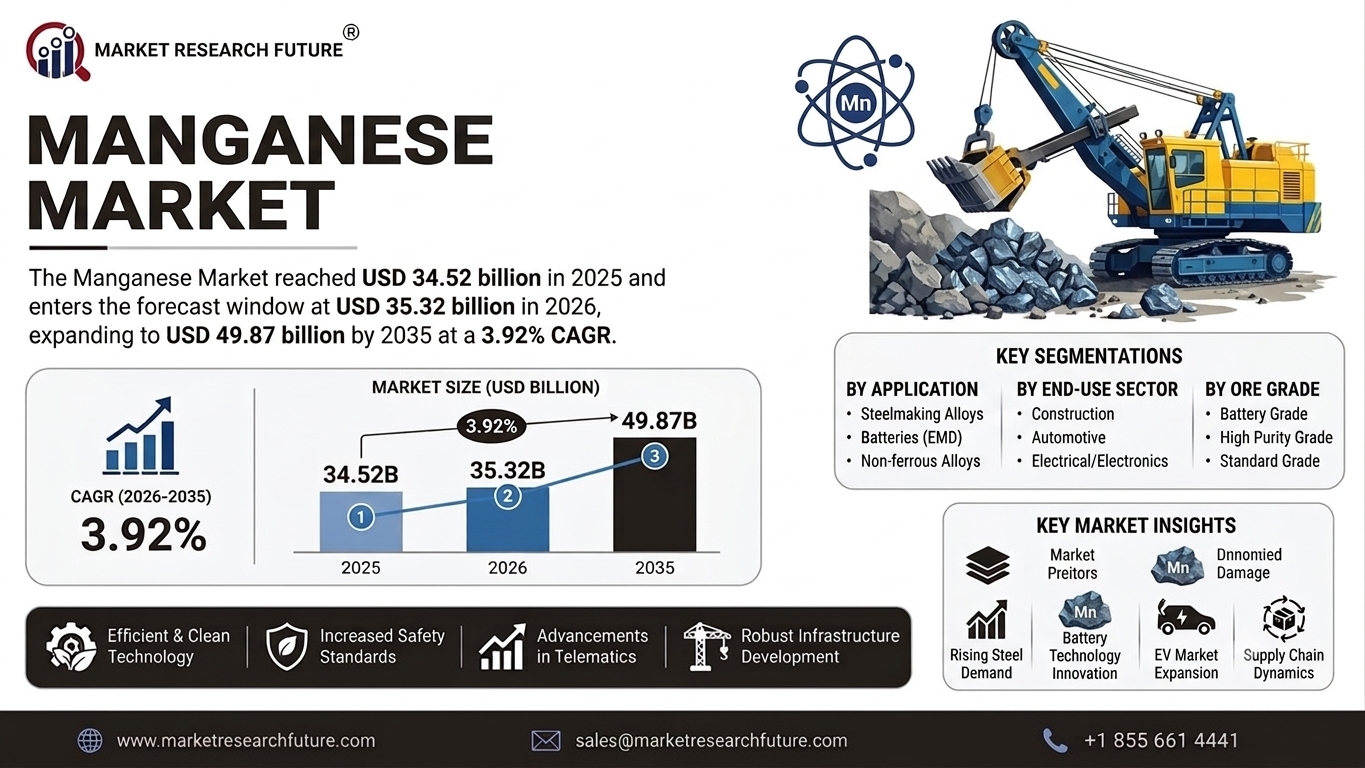
GA, UNITED STATES, September 8, 2026 /EINPresswire.com/ — The Manganese Market is expanding as manganese remains essential to steelmaking while gaining strategic importance in advanced battery technologies and clean-energy supply chains. The market was valued at USD 34.52 billion in 2025 and is projected to reach USD 49.87 billion by 2035, growing from USD 35.32 billion in 2026 at a 3.92% CAGR during the forecast period. Rising steel production, hydrogen-based direct reduced iron (DRI), electric vehicle adoption, and demand for battery-grade manganese are reshaping the global market.
Manganese is primarily used as an alloying element to improve the strength, hardness, durability, and wear resistance of steel. At the same time, high-purity manganese products are becoming increasingly relevant to lithium-ion and lithium-manganese-iron-phosphate (LMFP) battery chemistries. This combination of established industrial demand and emerging energy applications is creating a broader growth platform for manganese producers and refiners.
Steel Production Remains a Core Market Driver
Steel continues to represent a fundamental source of manganese demand. Manganese is used in ferroalloys and steelmaking to support deoxidization, desulfurization, strength, and hardness. Construction, infrastructure, automotive manufacturing, heavy machinery, and other industrial applications therefore remain closely connected to manganese consumption.
The transition toward lower-carbon steelmaking is also influencing manganese requirements. Hydrogen-based DRI and electric arc furnace routes can increase alloy addition intensity, creating additional demand for manganese-bearing materials. Announced DRI capacity exceeding 42 million tonnes per year is expected to contribute to incremental alloy demand as new production capacity develops.
Infrastructure-led steel consumption is another supporting factor. Rebar-intensive construction activity in India, ASEAN markets, and the Middle East is sustaining demand for steel grades that rely heavily on manganese alloys.
Battery Technologies Expand Manganese Demand
The growing electric vehicle and energy-storage industries are creating a new demand channel for manganese. Battery manufacturers are increasingly evaluating manganese-rich chemistries because manganese can contribute to cost efficiency, thermal stability, and energy-density improvements.
LMFP cathode technology is particularly important. Unlike conventional lithium iron phosphate chemistries, LMFP incorporates manganese into the cathode structure, potentially increasing the requirement for high-purity manganese sulfate. Adoption in commercial electric vehicles could therefore create substantial incremental demand for battery-grade manganese.
Electrolytic manganese dioxide is also benefiting from demand for batteries and grid-scale energy storage. The segment is projected to expand at a 6.62% CAGR, while the Power Storage and Electricity end-use sector is forecast to grow at 6.79%, making it the fastest-growing end-use segment.
Download Report Sample Copy with TOC: https://www.marketresearchfuture.com/sample_request/7724
Alloys Continue to Dominate the Application Segment
By application, alloys accounted for 62.9% of the Manganese Market in 2025. The segment benefits from the continued use of ferroalloys in finished steel production across construction, automotive, infrastructure, and industrial manufacturing.
Electrolytic manganese metal generated USD 4.91 billion in 2025, supported by applications in stainless steel and specialty alloys. Meanwhile, electrolytic manganese dioxide is gaining momentum because of its connection to battery and energy-storage applications.
This creates an increasingly diversified market structure in which traditional alloy demand provides scale while battery-related applications create higher-value opportunities for refined manganese products.
Battery-Grade Manganese Creates a Higher-Value Opportunity
By ore grade, standard-grade manganese represented 54.9% of volumes in 2025, reflecting the continued importance of conventional industrial applications. However, battery-grade manganese is projected to grow at a 6.91% CAGR through 2035, making it one of the most attractive growth areas in the market.
High-purity grade manganese generated USD 6.35 billion in 2025. Increasing demand for refined manganese sulfate and other specialty products is encouraging investment beyond traditional mining and ferroalloy production.
The shift toward value-added products is particularly important because battery manufacturers require tighter impurity specifications than conventional steel applications. Producers with refining capabilities can therefore capture additional value across the manganese supply chain.
Asia-Pacific Leads Global Demand
Asia-Pacific accounted for 57.4% of Manganese Market demand in 2025, making it the dominant regional market. China and India are major contributors because of their substantial steel industries, while the region is also becoming increasingly important for battery manufacturing and energy-storage supply chains.
China remains a major manganese consumption and processing hub, particularly for silicomanganese and ferromanganese production. India is expanding its steel and battery manufacturing capacity, supporting additional manganese demand.
Japan, South Korea, Indonesia, and Australia also contribute through mining, processing, steel production, and battery-related activities.
Middle East and Africa Offer Strong Growth Potential
The Middle East and Africa is projected to be the fastest-growing regional market, with a 6.28% CAGR. The region benefits from substantial manganese resources, expanding steelmaking capacity, and investments in mineral processing and downstream industrial infrastructure.
South Africa remains strategically important as a major manganese ore producer. At the same time, countries across Africa are increasingly interested in beneficiation and local processing rather than exporting only raw ore.
Saudi Arabia is also investing in ferroalloy and downstream refining capacity, supporting the development of a more diversified manganese supply chain outside traditional processing centers.
Buy Now: https://www.marketresearchfuture.com/checkout?currency=one_user-USD&report_id=7724
Sustainability Is Reshaping Manganese Production
Environmental requirements are becoming increasingly important across manganese mining and processing. Producers face growing pressure to reduce emissions, improve energy efficiency, strengthen mine-site management, and provide transparent supply-chain information.
The European carbon-pricing environment is increasing the value of low-emission manganese and ferroalloy production. Renewable-powered smelting can therefore provide producers with a competitive advantage where customers are willing to pay premiums for lower-carbon materials.
Digital technologies are also improving mining efficiency. Automation, artificial intelligence, digital resource estimation, and process optimization can increase ore recovery, reduce operational risks, and improve resource utilization.
Recycling Creates a New Supply Opportunity
Recycling is emerging as an important opportunity for reducing dependence on primary manganese extraction. Spent batteries and electric arc furnace dust can provide secondary manganese feedstock for recovery and processing.
Recycled feedstock can help address both supply security and sustainability objectives. As carbon costs increase and manufacturers seek lower-emission materials, secondary manganese could become increasingly competitive with conventional supply.
This opportunity is particularly relevant to regions attempting to establish domestic critical-mineral supply chains. Recycling can complement mining and refining investments while reducing exposure to international ore supply disruptions.
Supply-Side Risks Remain a Major Challenge
Despite favorable demand prospects, manganese producers face supply and cost-related challenges. Ore price volatility, energy costs, permitting requirements, and geographically concentrated production can create significant uncertainty.
The absence of a deep exchange-traded futures market leaves many buyers exposed to fluctuations in manganese prices. This can make it difficult for smaller alloy producers to hedge raw-material costs effectively.
Mining projects can also face lengthy environmental approvals and community-consent requirements. These constraints can delay new supply at a time when battery-grade manganese demand is increasing.
Energy costs represent another important challenge. Ferroalloy smelting is energy intensive, making producers particularly sensitive to electricity prices and grid reliability.
Key Opportunities for Market Participants
Several opportunities are expected to shape the next phase of the Manganese Market. High-purity manganese sulfate production represents one of the most attractive areas because of its connection to EV batteries and energy storage.
Renewable-powered smelting clusters can help producers reduce emissions while improving their positioning in markets where customers prioritize low-carbon materials. Emerging-market beneficiation capacity can also shift more value creation toward resource-rich regions in Africa and other producing areas.
Digital traceability provides another opportunity. Automakers and battery manufacturers increasingly need information about the origin, emissions profile, and processing history of critical minerals. Producers capable of providing verified chain-of-custody and ESG data can potentially differentiate their products from conventional commodity supply.
Report Summary: https://www.marketresearchfuture.com/reports/manganese-market-7724
Competitive Landscape
The competitive landscape includes major mining and materials companies such as South32 Limited, Eramet SA, Anglo American plc, Vale S.A., Assmang Proprietary Limited, and Tshipi é Ntle Manganese Mining.
Competition is increasingly extending beyond ore production. Companies are investing in beneficiation, high-purity refining, low-carbon processing, battery-grade materials, and supply-chain partnerships to capture value from emerging demand.
Related Report
Silico Manganese Market https://www.marketresearchfuture.com/reports/silico-manganese-market-9584
nickel cobalt manganese market https://www.marketresearchfuture.com/reports/nickel-cobalt-manganese-market-41098
manganese mining market https://www.marketresearchfuture.com/reports/manganese-mining-market-27977
electrolytic manganese metal market https://www.marketresearchfuture.com/reports/electrolytic-manganese-metal-market-25051
ferro manganese market https://www.marketresearchfuture.com/reports/ferro-manganese-market-25185
electrolytic manganese dioxide market https://www.marketresearchfuture.com/reports/electrolytic-manganese-dioxide-market-25043
Market Research Future
Market Research Future
+ +1 855-661-4441
email us here
Legal Disclaimer:
EIN Presswire provides this news content “as is” without warranty of any kind. We do not accept any responsibility or liability
for the accuracy, content, images, videos, licenses, completeness, legality, or reliability of the information contained in this
article. If you have any complaints or copyright issues related to this article, kindly contact the author above.

Media gallery
